
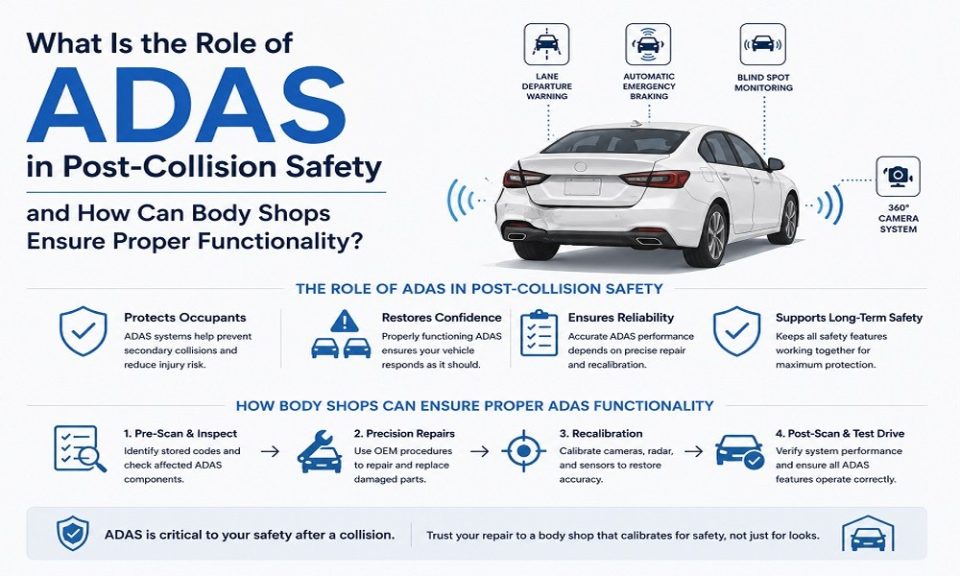
ADAS Calibration is a key step that ensures all ADAS features in your vehicle are operating correctly. Whether it is improving sensor performance, preventing system malfunctions, or minimizing future expenses, ADAS calibration is crucial to ensuring your advanced safety systems remain operational. As such, it is vital to ensure that all advanced safety systems in your vehicle are calibrated whenever repair work is done or after a collision.
Why ADAS Matters After Impact
Main Safety Focus
The ADAS uses cameras, radar sensors, ultrasonic sensors, control modules, and software to analyze the car’s surroundings. After an accident, these components might not suffer visible damage; however, their displacement might impair operation. The front camera will be mounted behind the windscreen, the radar sensor behind the bumper, and the side sensors will be located on panels that can withstand impact forces. A malfunction in any of these components might result in an inaccurate interpretation of lane markers, distances to other cars, and obstacles. This can adversely affect drivers’ confidence and increase the danger of driving. Body shops can assist with analyzing which ADAS system was fitted in the vehicle and perform the necessary scans and calibrations according to the manufacturer’s specifications. Lane assist calibration in Houston is an example of a location-based service phrase often used when drivers need lane-support systems checked after collision-related work. The objective is to ensure proper operation rather than to repair the damage itself.
Why Visual Completion Is Not Enough
The car might be looking good after coming out of the body shop. It may look like the work was done perfectly, but the ADAS systems might still require work. Modern cars have driver-assistance systems that require proper calibration. They need to be placed in their precise positions, without any interference. The cameras need to have unobstructed views, the sensors need to be installed correctly, and the ride height needs to be just right. The systems need to communicate perfectly with the car’s computer system. Any misalignment will cause issues with ADAS operation. Even a slight misalignment will affect how the system works. The system is designed to help drivers when it counts the most. Therefore, there must be a procedure for dealing with the systems. There must be an assessment of the systems before and after the repair work.
Scanning and System Identification
The first step for body shops would be to determine whether the vehicle has ADAS systems before any mechanical work is done. Most drivers are unaware of all the systems on board, and even within a model, there can be differences between trim levels. The vehicle build sheet, dashboard displays, scanner, and manufacturer information can be used to determine the active systems. Prework scanning will identify existing error codes, sensor communication issues, and system warnings. Why does this matter? It provides a starting point for assessing the condition of vehicle systems without removing components, adjusting panels, working with glass, or connecting to electronic systems. After the work is completed, post-work scanning will confirm whether system communication has been reestablished and whether any remaining codes require attention. This approach ensures that both the driver and the shop are informed by measurement, not speculation. This is why ADAS work cannot be an afterthought in the event of a collision.
Calibration and Target Setup
Calibration is the process of retraining the ADAS modules of the car to accurately detect the road following repair work that alters the car’s structure, glass elements, sensor or system positions, or the condition of the electronics. Some calibrations are static, in which the car is placed in an area with specific targets, measurements, lighting standards, distances, and floor levels. There are dynamic calibrations that require the car to be driven under certain conditions to recalibrate its ability to track lane lines and other road features through its cameras and sensors. Shops should use the correct target boards, measurement tools, scans, batteries, and manuals provided by car manufacturers to calibrate ADAS units. Floor angle, tire air pressure, fuel, and distance from the target may all influence the results. Even tiny mistakes during the calibration setup can result in system malfunctions. Calibration also requires time because some cars require more conditions to be fulfilled for completion.
Parts, Panels, and Sensor Views
The choice of parts, fitment, and exposure in body shops also plays a major role in ADAS effectiveness. Many sensors are covered by painted bumpers, grilles, mirrors, windshields, or body panels, which means the materials and locations of these components can affect the sensor’s signal. A thick coating, incorrect brackets, a misfit panel, or obstructed sensors can negatively affect the operation of radar and camera sensors. The windshield replacement process deserves particular attention, as front-facing cameras may have specific requirements for the type of glass, the free installation area, and precise alignment. Certain side-view sensors may depend on the mirrors’ location, and rear cross-traffic sensors may be installed near the bumper corners. It is necessary for body shops to ensure that all sensors have the proper equipment installed and that nothing blocks or distorts their signals.
Documentation and Driver Handover
Another equally important factor in ensuring ADAS safety after a crash is thorough documentation of the entire repair procedure. This should include pre-ADAS scan results, post-repair scan results, procedures performed during calibration, target information and setup procedures, the type of equipment used, and any special requirements for the testing phase. Such a record proves that the body shop followed certain procedures in its ADAS repair work and provides the owner with detailed information on how the system was evaluated and calibrated. The driver handover also plays an important role here. A customer needs to be aware that ADAS helps them drive, but is not a substitute for paying attention and acting rationally on the road. Shops might provide the client with explanations of the system’s functioning, how it behaves in certain situations, and why their vehicle requires clean sensors, no obstructing objects on the windows, and proper tire pressure for smooth functioning.
Impact Safety With ADAS Technology
ADAS has shaped safety, as current-generation vehicles increasingly depend on sensors, software, cameras, radar, and precise alignment. In the event of a collision, ADAS systems must be scanned, calibrated, properly configured, have a clear field of view, and be documented before the vehicle is returned to the road. The benefit of checking ADAS systems at a body shop is that it protects the driver from malfunctions that may not be evident during a walkthrough.
